
7 Bridal Veil for Lehenga Mistakes That Can Ruin an Expensive Look

If you are choosing a bridal veil for your lehenga, please don’t treat it like the last accessory on your bridal checklist.
You can spend ₹3 lakhs, ₹5 lakhs, even more on an Indian bridal lehenga and the wrong bridal veil can still change the entire look.
How to Choose the Right Bridal Veil for Lehenga Looks
I have seen beautiful lehengas overwhelmed by overly heavy embroidery, cathedral bridal veils that were long but far too narrow, badly finished edges that refused to fall smoothly, visible joins, and personalised bridal veils where so many motifs were added that the bride disappeared underneath the story.
A custom bridal veil should do the opposite.
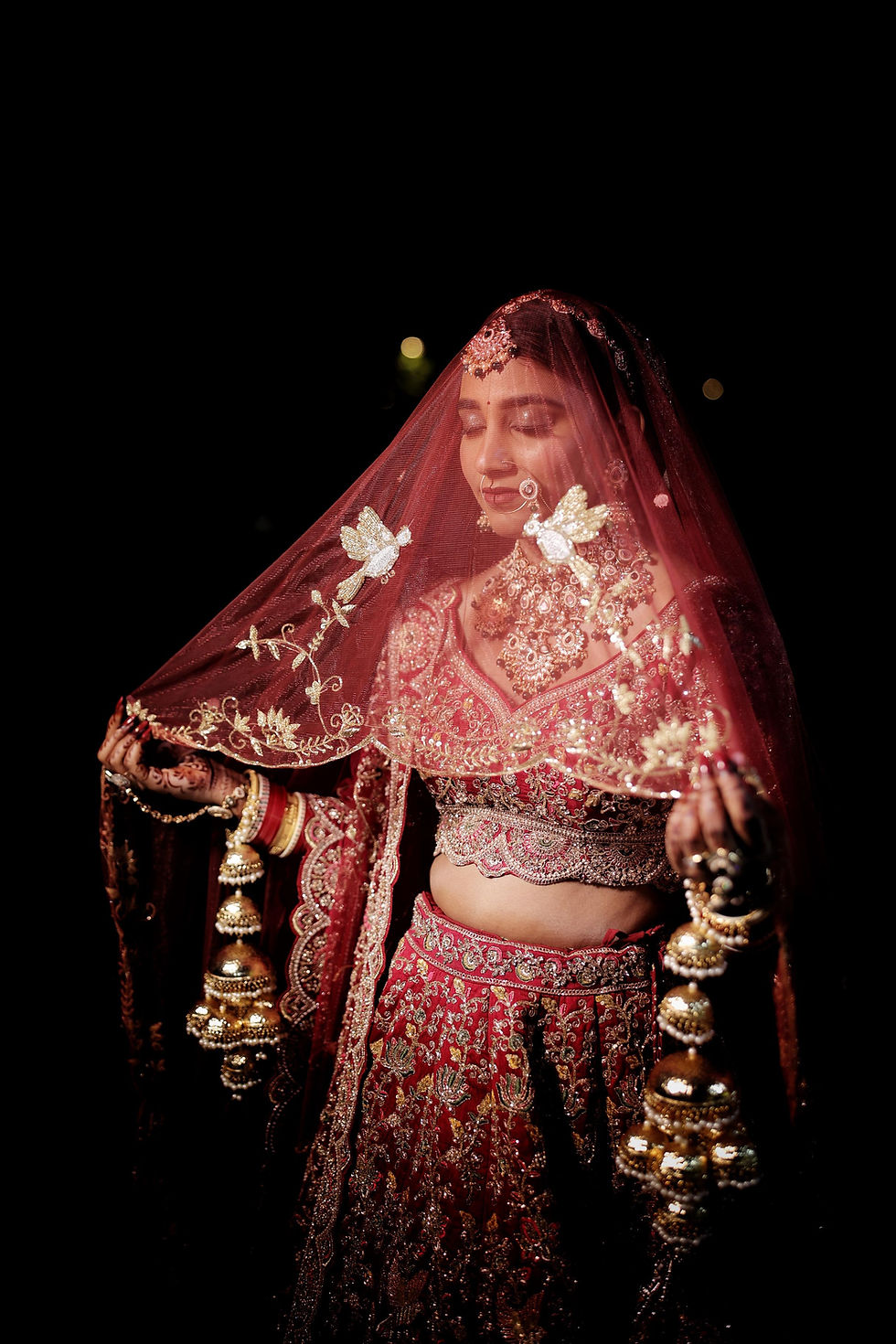
It should understand the lehenga, frame the bride and make the entire bridal silhouette feel more intentional.
Whether you are considering a hand embroidered bridal veil, personalised veil, cathedral veil or a simple seamless wide veil, these are the bridal veil mistakes I would avoid before ordering yours.

1. Choosing the veil after the entire look is already decided
This is probably the biggest one. The lehenga is done. Jewellery is done. Hairstyle is decided. Dupatta is decided.
And then suddenly, two weeks before the wedding:
“I also want a veil.”
At that point, you are not really designing a veil. You are trying to fit one into a look that was never designed to accommodate it. So you go and just pick up a veil from the local store or tell a veil brand “pp”, “how much”, “i want this”. Listen that’s exactly gonna pull your look south.
A good bridal veil should understand the lehenga — its embroidery placement, neckline, colour, flare, train, proportions and even how much visual weight is already around the bride.
The earlier you think about it, the more intentional the final look becomes.
2. Treating a veil like another dupatta
A veil and a dupatta do completely different jobs. A dupatta is usually draped around the body. A veil creates a frame around the bride.
It affects the height, width, movement and overall drama of the silhouette. So when someone simply copies the embroidery of the lehenga onto a piece of net and calls it a veil, it often looks like exactly that — another dupatta, just longer!
The veil needs its own composition.

3. Only thinking about length and forgetting width
Everyone asks:
“Cathedral hai?”“3 metre hai?”“How long is the trail?”
Very few brides ask how wide the veil is. And width matters just as much as length.
A very long but narrow veil can look flat from the back and give almost no front coverage. A properly proportioned veil opens around the bride, frames the lehenga and creates that full sweeping shape you are actually imagining when you save cathedral veil references.
Length gives drama.
Width gives presence.

4. Ignoring how the veil is constructed
This is one of those details you may not notice until someone points it out — and then you cannot unsee it.
Very wide veils sometimes require fabric to be joined. If those joins are visible through the centre or across an important part of the veil, they can interrupt the entire fall. So look for the ones who give no join veils. Sphinx was the first brand in India to gove no join veils, the seamless ones.
The same applies to finishing. Edges should fall smoothly. They should not look puckered, twisted, uneven or stiff simply because embroidery has been forced onto them badly.
Luxury is often not about adding more.
It is about whether everything sits beautifully.

5. Matching every single motif from the lehenga
Matching does not mean copying.
If your lehenga already has extremely dense embroidery, and then the veil repeats the same density everywhere, nothing gets to breathe.
The bride disappears somewhere between the lehenga, jewellery, dupatta and veil. Sometimes the best veil for a heavily embroidered lehenga is surprisingly delicate.
Sometimes a simpler lehenga can take a much more elaborate story veil.
The aim is balance, not maximum embroidery per square inch.

6. Choosing the veil in isolation
I have seen beautiful veils that simply do not belong with the outfit they were worn with.
The veil itself is not the problem. The combination is.
Colour is a huge part of this. Red is not just red. Ivory is definitely not just ivory. Gold can be yellow, antique, champagne, pale or almost silver.
Even the transparency of the fabric changes the final colour once it falls over your lehenga and skin.
I would always look at the veil against the actual bridal outfit before finalising it.
7. Leaving customisation too late
Personalisation sounds simple until you actually start designing it.
Names. Dates. Coordinates. Places. Flowers. Pets. Architecture. Religious symbols. Family references. Things only the bride and groom understand.
If you want a veil to carry your story, it needs composition.
Otherwise it becomes a collection of random motifs floating on net.
And that is the difference between something personalised and something designed. Give your designer enough time to edit.

Not every memory belongs on the veil.
The right ones do.
Wanna check out how we make stories into veil?
The veil should make the lehenga look better
That is really the rule.
Your veil should not compete with the outfit you spent months choosing.
It should change how that outfit feels when you walk into the room.
Sometimes that means a huge cathedral veil.
Sometimes it means barely-there embroidery.
Sometimes it means creating an entire story across the train.
But it should always feel intentional.
Because a ₹5 lakh lehenga cannot save the wrong veil.
And the right veil can completely transform the bridal look.
Your bridal veil shouldn’t be an afterthought. Choose a house that designs it like part of the entire bridal look.


Comments